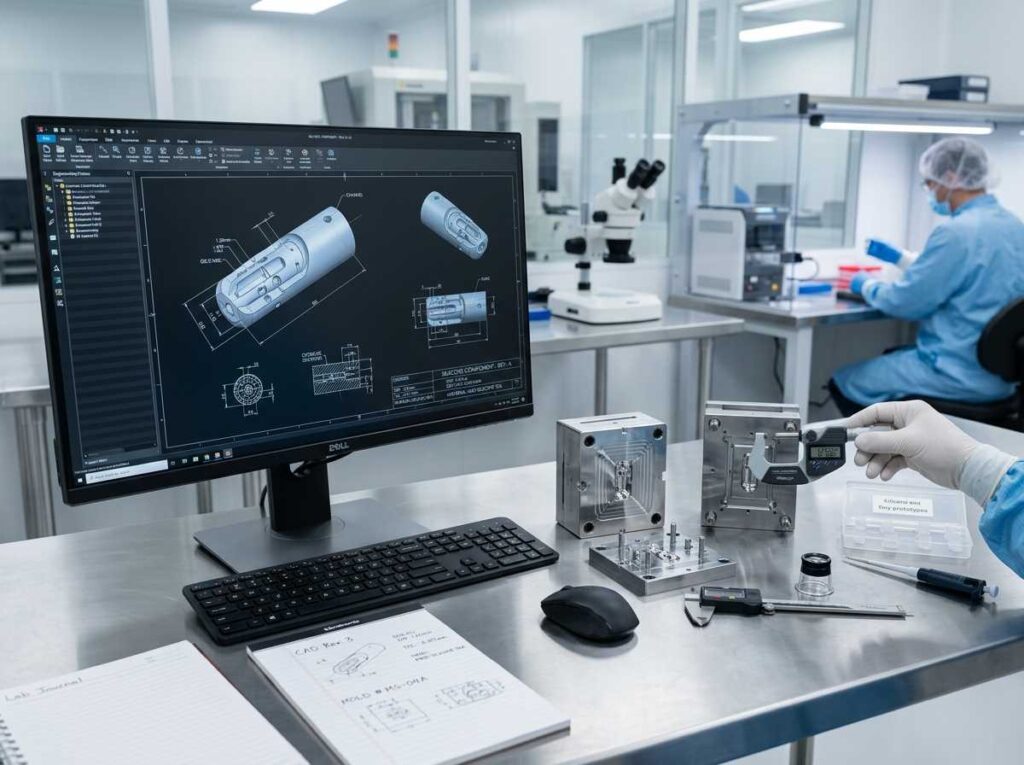
Choosing the right silicone component can make or break a medical device’s performance. This guide walks through the four decisions that matter most, from material grade to wall thickness, so engineers and procurement teams can specify with confidence.
Choosing the Right Silicone Grade
Not all silicone is the same. Injection-moulded LSR and extrusion-grade HCR behave differently under sterilisation, so the material grade should be locked early in design.
What to Ask Your Supplier
- Biocompatibility: Confirm ISO 10993 compliance for the exact grade, not just the family.
- Sterilisation: Autoclave, EtO, or gamma — each stresses the material differently.
- Hardness: Shore A 40 to 70 covers most sealing and valve applications.
Designing for Consistent Wall Thickness
Thin spots crack during demoulding; thick spots sink or trap air. Keep walls as uniform as possible and let the supplier flag critical sections before tooling is cut.
Validating Before Volume Production
Run a short pilot, measure the critical dimensions, and only then commit to full tooling. This is the cheapest place to catch a tolerance problem.